
Microgrid Load Shedding: How Critical Loads Are Protected During Islanded Operation
Microgrid load shedding disconnects lower-priority electrical loads when local generation cannot support total demand. Learn how controllers protect critical loads and stabilize an islanded microgrid.
Published · 11 min read

Microgrid load shedding protects an islanded power system by disconnecting lower-priority electrical loads when available local generation cannot support everything connected to the microgrid.
While connected to the utility grid, a facility can normally import additional electricity when its own generation is insufficient.
That safety net disappears when a microgrid islands.
Generation and electricity demand must then remain balanced within the local electrical system. If a generator trips, solar production suddenly falls or demand exceeds the available supply, the microgrid needs another way to restore that balance.
One option is to reduce demand.
That is the purpose of microgrid load shedding.
What is microgrid load shedding?
Microgrid load shedding is the intentional disconnection or reduction of selected electrical loads to keep the remaining microgrid stable when available generation cannot meet total demand.
The basic principle is straightforward:
Available generation must approximately match the load that remains connected.
If a 5 MW islanded microgrid suddenly loses a 2 MW generator while carrying 4.5 MW of load, the remaining resources may not be capable of supplying that demand.
The control system may therefore disconnect lower-priority loads quickly enough to prevent the entire island from collapsing.
Load shedding is not simply a blackout on a smaller scale. It is a controlled action intended to prevent a larger loss of service.
Why load shedding becomes important when a microgrid islands
The utility grid normally acts as an enormous balancing system.
If a grid-connected facility’s load increases by 500 kW, the additional power can usually flow through the utility connection without the facility needing to start another local generator immediately.
During islanded operation, only resources inside the microgrid are available.
Those may include:
- Battery energy storage
- Solar PV
- Dispatchable generators
- Fuel cells
- Combined heat and power
- Other local generation
If local generation becomes insufficient, system frequency can begin to decline.
In severe cases, generators or inverters can trip, causing an even larger imbalance and potentially producing a complete microgrid blackout.
The microgrid controller and associated protection/control systems therefore need a strategy for reducing demand when the available supply cannot sustain every connected load.
Critical loads come first
Load shedding works only if the microgrid knows which loads matter most.
That prioritization should begin during design rather than during an emergency.
A hospital might classify operating rooms, life-safety equipment and essential clinical systems as the highest priority.
A municipal microgrid may prioritize police, fire, emergency communications and water infrastructure.
A data center may protect computing, networking and the cooling systems required to keep those assets operating.
Lower-priority loads might include decorative lighting, selected HVAC zones, EV charging or nonessential process equipment.
Microgrid Media’s guide to microgrid design explains why identifying critical and noncritical loads before sizing generation can substantially reduce the amount of capacity required for resilient operation.
How a load-shedding sequence works
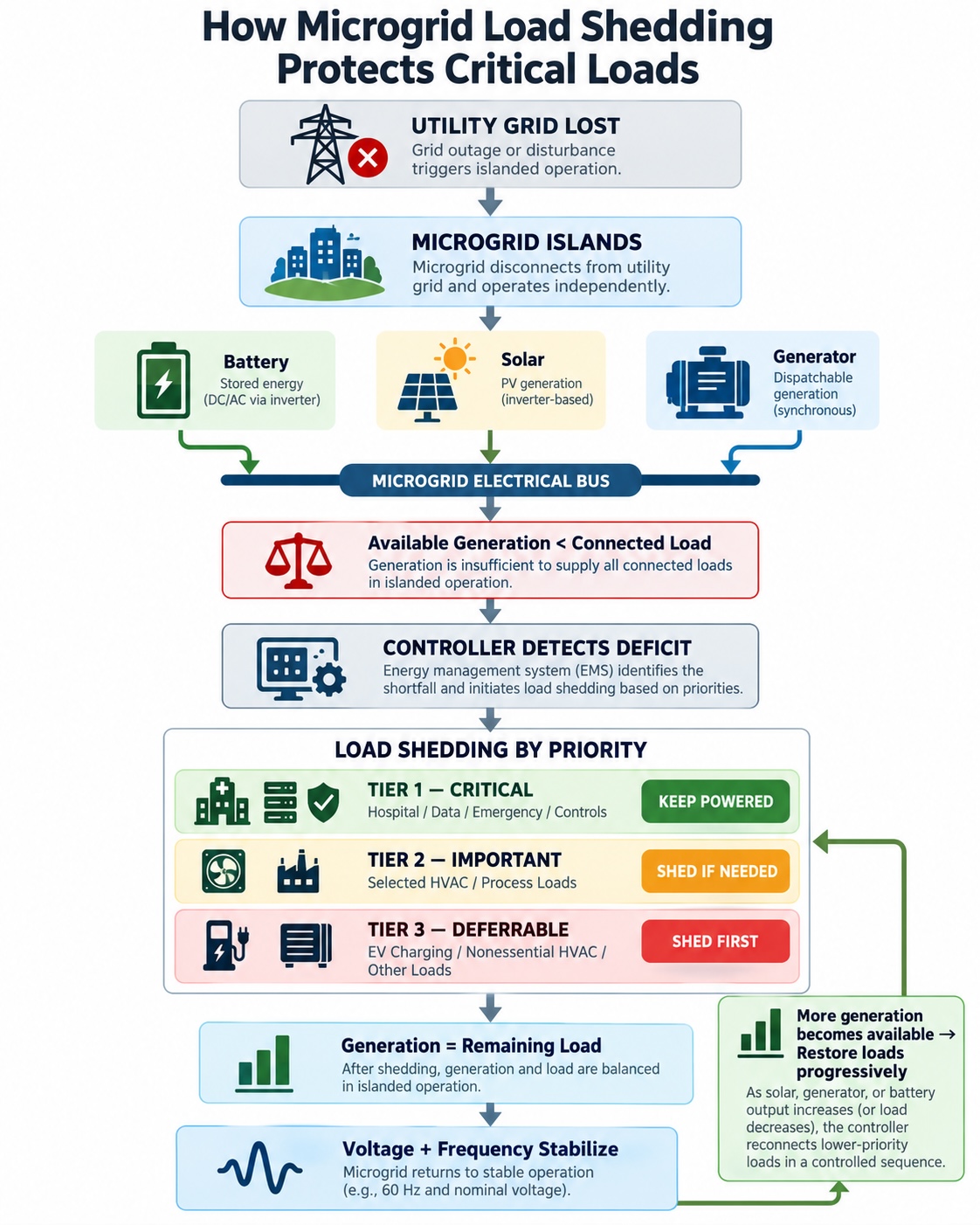
The precise sequence varies by project, but the control logic can be understood in several stages.
1. Detect the power deficit
The microgrid first needs to recognize that available generation is no longer sufficient.
Possible indicators include:
- Loss of a generator
- Opening of the utility interconnection breaker
- Low system frequency
- Battery power limits
- Low battery state of charge
- Loss of renewable generation
- Unexpected load increase
2. Determine how much load needs to be removed
The system then needs to estimate the deficit.
If a 1 MW generator trips, simply shedding 100 kW may not restore balance.
Conversely, disconnecting 2 MW could unnecessarily interrupt useful services.
More sophisticated systems can use real-time measurements to select an appropriate amount of load.
3. Select lower-priority loads
Loads can be organized into priority groups.
A simple system might have three tiers:
- Tier 1: Essential loads that should remain energized whenever possible
- Tier 2: Important loads that can be interrupted under significant constraints
- Tier 3: Deferrable loads that can be shed first
The exact number of tiers is project-specific.
4. Open selected feeders or reduce controllable demand
The controller sends commands to the appropriate switching or load-control equipment.
Some loads may be completely disconnected.
Others can be reduced without being switched off entirely.
5. Verify that the system stabilizes
After demand is reduced, the controls monitor frequency, voltage, generation and available reserves.
If the first action is insufficient, another load tier may need to be shed.
Load shedding can be triggered in different ways
Not every microgrid uses the same trigger.
Event-based shedding
The control system can respond directly to a known event.
If a 1.5 MW generator breaker opens, the controller knows a specific source has been lost and can immediately remove an appropriate group of loads.
This can be faster than waiting for frequency to fall substantially.
Underfrequency load shedding
Frequency provides an important indicator of the balance between generation and demand in an islanded AC system.
When demand exceeds available generation, frequency tends to decline.
Underfrequency logic can shed loads when predefined thresholds are crossed.
The thresholds and timing need careful engineering because unnecessary shedding is undesirable, while waiting too long can allow the disturbance to become more severe.
State-of-charge-based shedding
A battery-supported microgrid can also use stored-energy conditions as an input.
Imagine that a microgrid successfully islands with a battery at 80% state of charge.
Several hours later, the battery reaches a reserve threshold while renewable generation remains low.
The controller may disconnect another tier of noncritical load to extend the remaining operating duration.
Forecast-based load management
A supervisory energy-management system can sometimes act before an emergency threshold is reached.
If forecasts indicate that available generation will be insufficient overnight, lower-priority demand can be reduced earlier rather than waiting until the battery is nearly depleted.
This connects load shedding with the broader role of the microgrid EMS: optimization can help avoid emergency actions, while faster control layers respond when conditions change unexpectedly.
Load shedding and demand response are not the same thing
Both reduce electricity consumption, but their objectives and timing can be very different.
| Load Shedding | Demand Response |
|---|---|
| Often protects electrical stability or critical service | Usually responds to grid or economic signals |
| Can occur extremely quickly | Often scheduled or requested in advance |
| May disconnect feeders automatically | May reduce or shift discretionary consumption |
| Common during constrained island operation | Common while connected to the wider grid |
| Primary objective may be avoiding collapse | Primary objective may be reducing peak demand or supporting the grid |
The technologies can overlap. A controllable HVAC load might participate in ordinary demand response while grid connected and become a shed-able load during an islanded emergency.
Why batteries do not eliminate the need for load shedding
Battery storage can respond extremely quickly to a sudden generation deficit.
That makes batteries valuable during transitions and disturbances.
But a battery has two different limits:
- Power: how much electricity it can deliver at a particular moment
- Energy: how long it can continue delivering electricity
A battery may successfully cover the immediate loss of a generator but lack enough stored energy to support the entire load for several hours.
Load shedding can therefore work alongside storage.
The battery handles the fast transient while lower-priority demand is reduced and dispatchable generation starts or ramps.
What happens to frequency during a generation shortfall?
Frequency is one of the clearest indicators that an islanded AC power system is out of balance.
When electricity demand exceeds generation, frequency tends to fall.
If the imbalance is sufficiently large, generating resources may reach operating limits or trip on protective settings.
This can create a cascading problem: losing one resource makes the remaining deficit even larger.
Load shedding attempts to interrupt that progression by reducing demand before the system reaches an unrecoverable condition.
This relationship also connects directly to microgrid power quality, where maintaining acceptable voltage, frequency and waveform conditions becomes particularly important after the utility reference disappears.
Load shedding during the transition to islanded operation
The moment a microgrid separates from the utility can create an immediate mismatch.
Suppose a campus is importing 2 MW immediately before an outage.
When the interconnection breaker opens, that imported 2 MW disappears.
Local resources must replace it almost immediately.
A battery may respond first. Generators may start or increase output. Noncritical loads may be shed.
The control strategy needs to coordinate those actions so the transition does not destabilize the island.
IEEE 2030.7 defines common microgrid-controller functions for systems that operate grid connected or autonomously and transition between those conditions.
Load shedding during a long outage
Not all shedding occurs in the first seconds of an outage.
A microgrid can initially have enough generation to serve most loads but become constrained later.
For example:
- Battery state of charge declines.
- Fuel supply becomes limited.
- A generator requires maintenance.
- Cloud cover reduces solar production.
- Facility demand increases unexpectedly.
The controller may then move progressively through additional load tiers.
This makes microgrid load shedding part of energy endurance as well as immediate electrical stability.
Load restoration is the other half of the strategy
Disconnecting loads is only half the problem.
When additional generation becomes available, operators generally want to restore service.
Loads should not necessarily all return simultaneously.
Large motors, pumps, compressors and transformers can create substantial startup demand.
Restoration may therefore occur in stages.
The controller can reconnect higher-priority loads first, verify that the system remains stable and then progressively restore lower-priority loads as generation and reserves permit.
This same principle appears in microgrid black start, where loads and generation are restored in a deliberate sequence after the local system has become completely de-energized.
How microgrid load shedding supports resilience
Resilience is not simply the ability to produce electricity locally.
It is the ability to maintain the services that matter through a disruption.
A microgrid with 5 MW of critical and noncritical demand but only 3 MW of sustainable islanded generation can still provide meaningful resilience if it can identify and preserve the correct 3 MW.
A system without load prioritization may instead overload its resources and lose everything.
That is why microgrid resilience depends on the interaction among generation, storage, controls, electrical protection and critical-load management.
Real-world load-control strategies can use multiple priority classes
Microgrid control strategies have long used explicit load prioritization.
A U.S. Department of Energy microgrid demonstration report, for example, described a control strategy that classified loads into A, B and C groups, with A representing the most critical loads and C the least critical. The system could change which loads remained connected according to operating conditions and battery state of charge.
The specific architecture is project-dependent, but the principle remains useful: loads need predefined priorities before an emergency occurs.
How should critical-load tiers be designed?
Load priority should reflect the service the equipment provides, not merely its electrical size.
Useful questions include:
- Does loss of this load create a life-safety risk?
- Does another critical service depend on it?
- How long can it remain off?
- Can it operate at reduced capacity?
- Does it have a large startup current?
- Can operators override its priority?
- What happens when the load is restored?
A cooling pump may appear secondary until engineers recognize that critical computing equipment cannot operate without it.
Load classification therefore requires operational knowledge as well as electrical engineering.
Load shedding should be tested, not merely programmed
Control logic that exists in software has not necessarily been proven under real operating conditions.
Commissioning should verify that the intended loads actually disconnect, the correct breakers operate, communications work, the remaining system stabilizes and loads can later be restored.
IEEE’s microgrid-controller testing standard establishes procedures for verifying and quantifying common microgrid-controller functions.
Testing becomes especially important when the shedding sequence depends on several manufacturers’ equipment communicating correctly.
Frequently Asked Questions
What is microgrid load shedding?
Microgrid load shedding is the controlled reduction or disconnection of selected electrical loads when available generation cannot support total demand. Its purpose is to preserve higher-priority loads and maintain stable microgrid operation.
Why does an islanded microgrid need load shedding?
Once islanded, the microgrid cannot automatically import additional electricity from the utility. If local generation becomes insufficient, reducing lower-priority demand may be necessary to keep generation and load balanced.
Which loads are shed first?
That depends on the project’s predefined priority structure. Nonessential or deferrable loads are normally candidates for earlier shedding, while life-safety and mission-critical services receive higher priority.
Does load shedding always shut equipment completely off?
No. Some loads can be curtailed or operated at reduced capacity. The appropriate action depends on the equipment and control architecture.
Can batteries prevent load shedding?
Batteries can reduce the need for shedding by responding quickly to power deficits, but they have finite power and energy capacity. Longer outages or large generation losses can still require demand reduction.
Can shed loads be automatically restored?
Yes. A controller can restore loads as sufficient generation and reserve become available, although restoration is often staged to avoid creating another sudden demand imbalance.
The bottom line
Microgrid load shedding is controlled sacrifice: lower-priority demand is reduced so the services that matter most can remain powered.
Its value becomes clearest during islanded operation, when the utility can no longer compensate for a local generation shortfall.
A well-designed strategy identifies critical loads before an outage, detects supply-demand imbalances quickly, removes only as much load as necessary and restores service progressively when conditions improve.
Combined with batteries, dispatchable generation, protection and intelligent controls, load shedding gives a microgrid another way to remain stable when available power becomes constrained instead of allowing one shortage to become a complete local blackout.


