
Microgrid Cybersecurity: How to Secure Controllers, DERs and Islanded Operations
Microgrid cybersecurity protects the controllers, communications and operational technology that coordinate batteries, generators, protection systems and other DERs. Learn how segmentation, access controls, monitoring and recovery strengthen resilient operation.
Published · Updated · 10 min read

Microgrid cybersecurity is the protection of the digital systems that monitor, coordinate and control a microgrid’s electrical equipment. Because modern microgrids depend on controllers, relays, inverters, battery-management systems, meters, communications networks and remote access, a cyber incident can become an operational power-system problem rather than simply an information-technology problem.
A compromised office laptop may expose data. A compromised microgrid controller or protection device can affect how batteries dispatch, how generators start, which breakers operate and whether a facility can transition safely into islanded operation.
That is why cybersecurity has to be designed around the operational technology, or OT, environment and its safety, reliability and availability requirements.
What is microgrid cybersecurity?
Microgrid cybersecurity combines architecture, access control, monitoring, configuration management, incident response and recovery practices to protect the digital systems that operate the microgrid.
The National Institute of Standards and Technology’s SP 800-82 Rev. 3 remains the current final NIST guide for operational technology security. It emphasizes that OT security must account for performance, reliability and safety requirements that differ from conventional business IT.
NIST published an initial public draft of SP 800-82 Rev. 4 on September 21, 2026. The draft expands alignment with the Cybersecurity Framework 2.0, zero-trust concepts, asset management and network monitoring, but it is not yet a final standard and should be treated accordingly.
Why microgrids create a distinctive cybersecurity problem
A microgrid is a cyber-physical system.
Its software does not merely calculate reports. It can influence real electrical equipment.
Depending on the architecture, networked components can include:
- Microgrid controller
- Energy management system
- Battery management system
- Solar and battery inverters
- Generator controls
- Protective relays
- Revenue and operational meters
- SCADA systems
- Building-management systems
- Weather and forecasting services
- Remote vendor support systems
- Utility communications interfaces
Sandia National Laboratories’ Microgrid Cyber Security Reference Architecture uses defense-in-depth, network segmentation and functional domains to reduce the consequences of compromise inside a microgrid control environment.
Those principles remain relevant because increasing connectivity expands both operational capability and attack surface.
Start with the assets that can change electrical behavior
A good cybersecurity program begins with knowing what exists and what it can do.
Asset inventory should identify more than IP addresses. Operators need to understand which devices can:
- Open or close breakers
- Change inverter setpoints
- Start or stop generators
- Alter battery dispatch
- Change protection settings
- Shed or restore loads
- Modify islanding or reconnection logic
- Update firmware or controller code
That functional context helps prioritize protection. A weather sensor and a PCC protection relay may both be networked devices, but they do not present the same operational consequence if compromised.
Separate business IT from operational technology
Network segmentation is one of the most important microgrid security principles.
The control network should not be treated as another flat extension of the corporate office network. Internet-facing applications, business systems, vendor access and microgrid control functions should be separated according to their roles and risk.
Sandia’s reference architecture uses security enclaves and functional domains to limit unnecessary communication paths. DOE cybersecurity guidance for distributed energy resources similarly emphasizes defense in depth rather than reliance on one perimeter control.
Segmentation does not eliminate risk. It reduces how easily a compromise in one zone can spread to devices with more consequential control authority.
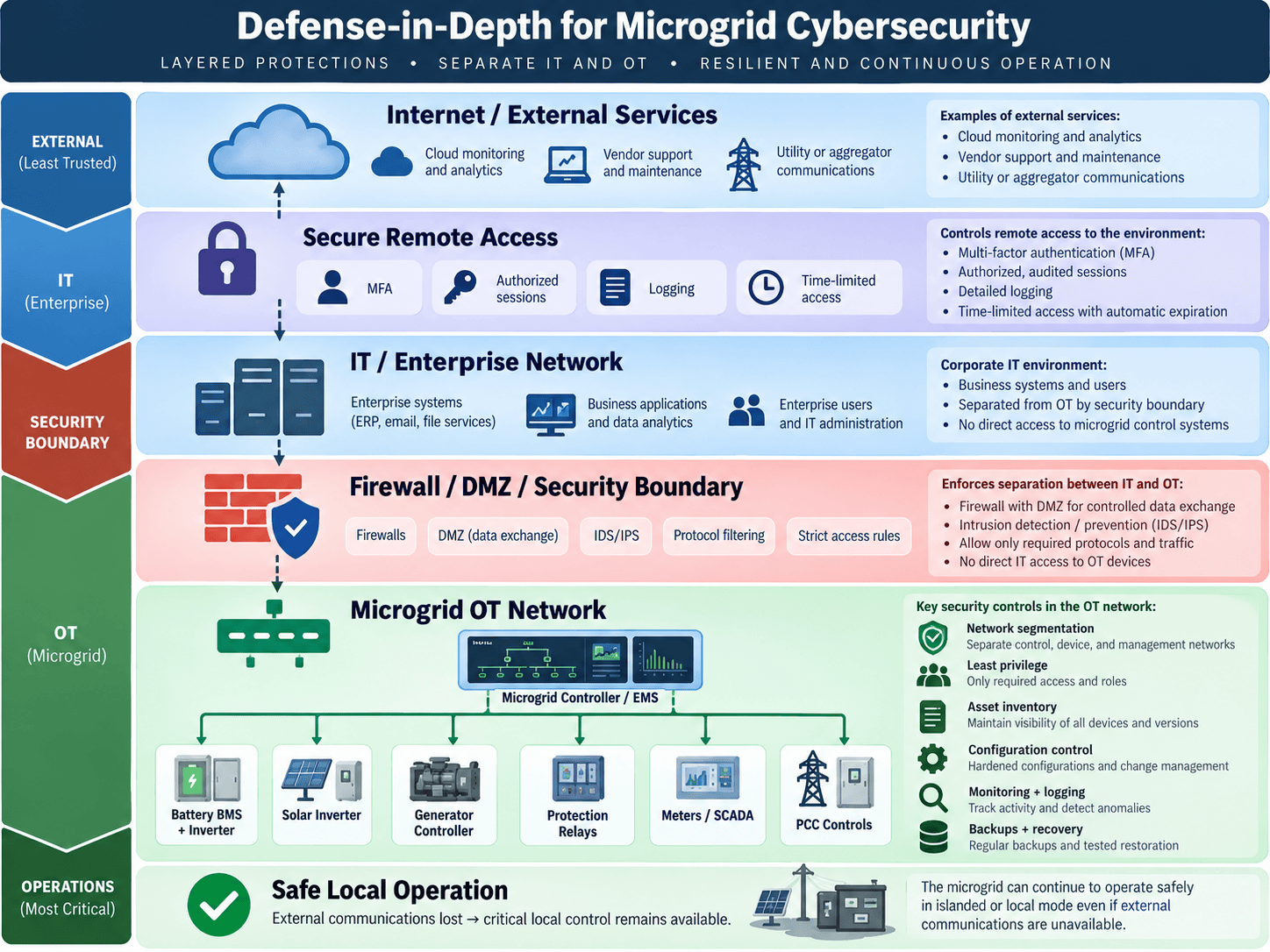
Secure the microgrid controller as a high-consequence asset
The microgrid controller can coordinate batteries, generators, loads and the utility connection. That makes it operationally valuable and potentially attractive to an attacker.
Security controls should account for:
- Administrative accounts
- Engineering workstations
- Remote access
- Configuration changes
- Software updates
- Controller backups
- Audit logs
- Communications with DERs
- Utility or aggregator interfaces
The objective is not merely to prevent someone from logging in. It is also to ensure that authorized changes are traceable and that the microgrid can recover if a controller is corrupted or unavailable.
Use strong identity and access control for DER systems
Distributed energy resources increasingly expose digital interfaces for monitoring and control.
Sandia’s DER access-control recommendations describe a model in which users are identified, authenticated and then authorized for a specific level of access, with accountability that can support forensic analysis.
In practical terms, projects should minimize shared accounts, separate operator from administrator privileges, require strong authentication for remote access and remove unnecessary credentials when personnel or vendors no longer need access.
Remote vendor access is useful—and dangerous if unmanaged
Microgrid equipment often requires vendor support. Remote access can reduce service time, but permanent unmanaged pathways into OT networks create avoidable risk.
A more defensible approach is to make remote access:
- Explicitly authorized
- Time limited where possible
- Protected with multifactor authentication
- Logged and monitored
- Restricted to the systems required for the maintenance task
- Disabled when not needed
Remote access should also be tested as part of incident-response planning. If the external connection has to be disabled during a cyber event, operators still need a way to run the microgrid locally.
Protect communications between controllers and DERs
Microgrid operation depends on measurements and commands.
If an attacker can alter telemetry, the controller may make incorrect decisions. If commands can be spoofed or replayed, an attacker may influence equipment directly.
Security can therefore involve authentication, encryption where technically appropriate, certificate or key management, network filtering and strict control over which systems are allowed to communicate.
The exact mechanism depends on device capability and protocol. Legacy equipment may not support modern security features, which makes network architecture and compensating controls especially important.
Cybersecurity and protection systems intersect
Protective relays are designed to act quickly when electrical faults occur. Increasingly, they also communicate over digital networks.
Sandia’s power-system protection research includes cybersecurity of protection relays alongside hardware-in-the-loop testing and adaptive protection. That reflects a broader reality: protection devices can no longer be treated as purely electrical components when their settings, logic or communications can be modified digitally.
Microgrid Media’s microgrid protection guide explains why relay coordination already changes between grid-connected and islanded conditions. Cybersecurity adds another requirement: ensure the logic and settings being relied upon have not been altered improperly.
Patch management in OT requires more care than ordinary IT
“Patch everything immediately” is not always an appropriate OT strategy.
Updates can affect controller compatibility, communications, certified configurations or vendor support. Applying a security patch without testing can introduce operational risk; failing to patch indefinitely can leave known vulnerabilities exposed.
A mature process therefore inventories firmware and software versions, assesses vulnerability severity and exploitability, tests changes when practical, schedules maintenance windows and documents accepted risk where updates cannot be applied immediately.
NIST’s OT guidance repeatedly emphasizes balancing cybersecurity controls with reliability and safety requirements.
Backups need to include configurations, not just files
Recovery depends on having a known-good system state.
For microgrids, backups can include:
- Controller logic
- Relay settings
- Inverter configurations
- Network-device configurations
- Certificates and key material where appropriate
- Historian and alarm configuration
- Device inventories
- Vendor software versions
- One-line diagrams and communications maps
NIST’s 2026 OT security publications also include an OT Backup Quick Start Guide, reflecting the importance of recovery planning in operational environments.
A backup is useful only if the team knows how to restore it and has verified that the required tools and credentials are available during an incident.
Design the microgrid to operate safely when external communications fail
Resilient operation should not depend on every cloud service, enterprise network or vendor connection remaining available.
If communications to a forecasting service or remote monitoring platform fail, the microgrid should enter a defined fallback state rather than behave unpredictably.
For critical facilities, operators should understand:
- Which functions continue locally
- Which optimization features are lost
- Whether islanding remains available
- Whether manual control is possible
- Which alarms remain visible
- How operators verify equipment status without the external service
This aligns cybersecurity with resilience instead of treating it as a separate compliance exercise.
Microgrid cybersecurity during islanded operation
Islanded operation can make cyber resilience more important because the microgrid is carrying critical loads with fewer external alternatives.
If a controller becomes unavailable while grid connected, the utility may still be serving the site. During an extended outage, loss of local control can directly threaten critical-load continuity.
The security design should therefore consider emergency operating states and the minimum trusted control functions required to keep the island stable.
Microgrid Media’s guide to microgrid resilience explains the electrical side of sustaining critical loads during utility outages. Cybersecurity ensures the digital control path remains dependable enough to support that strategy.
Monitor for abnormal behavior
Prevention will never be perfect. Operators also need visibility.
Monitoring can include:
- Authentication failures
- Unexpected configuration changes
- New network connections
- Changes to relay or inverter settings
- Unusual command patterns
- Unexpected remote sessions
- Communication failures between critical devices
- Software integrity alerts
DOE’s cybersecurity baselines for electric distribution systems and DER are intended to help utilities, regulators and DER operators prioritize foundational controls around critical assets.
Build an incident-response plan around electrical consequences
A cyber incident in a microgrid should not be handled only as an IT ticket.
The response team needs to know whether the suspected compromise affects:
- Grid-connected operation
- Islanding capability
- Black start
- Protection
- Battery dispatch
- Generator control
- Load shedding
- Utility communications
Response procedures should define who can isolate networks, who can authorize manual operation, how controllers are restored, how the utility is contacted and what evidence should be preserved.
The plan should also account for the possibility that the cyber event occurs during a physical outage.
Commission cybersecurity controls with the microgrid
Cybersecurity controls should be verified before the microgrid enters routine operation.
Commissioning can check account permissions, network segmentation, remote-access paths, logging, backup restoration, fail-safe behavior and control-system recovery in addition to the electrical tests described in Microgrid Media’s microgrid commissioning guide.
The objective is not to perform one penetration test and declare the system secure forever. It is to confirm that the installed architecture matches the intended security design and that operators know how to use it.
A practical microgrid cybersecurity checklist
- Maintain an accurate OT asset inventory.
- Document data flows and control relationships.
- Segment OT from corporate IT and public networks.
- Use least privilege for operators, engineers and vendors.
- Require strong authentication for remote access.
- Disable unused services and accounts.
- Control and document firmware and software updates.
- Protect relay, inverter and controller configurations.
- Monitor critical network and configuration changes.
- Maintain tested backups and restoration procedures.
- Define safe fallback modes for communication loss.
- Include cyber scenarios in emergency exercises.
- Review vendor support and vulnerability-disclosure processes.
- Reassess controls after major system changes.
Frequently asked questions
Why is microgrid cybersecurity different from normal IT security?
Microgrids are operational technology systems. Cyber actions can influence physical equipment, electrical stability and critical-load continuity, so security controls have to account for safety, reliability and real-time operational requirements.
What is the most important first step?
Know the assets and communication paths. An accurate inventory and architecture diagram make it possible to identify which systems can change electrical behavior and where segmentation or access controls are needed.
Should a microgrid be connected to the internet?
Some systems need external communications for monitoring, vendor support or market participation. The goal is not necessarily zero connectivity; it is controlled, authenticated, segmented and monitored connectivity with a defined fallback if external services are unavailable.
Does NIST have a microgrid-specific cybersecurity standard?
NIST SP 800-82 provides broad OT security guidance rather than a microgrid-only standard. Sandia and DOE provide additional microgrid- and DER-focused research and guidance that can be used alongside NIST’s OT framework.
Is NIST SP 800-82 Rev. 4 final?
No. As of October 2026, Rev. 3 remains the current final publication. Rev. 4 is an initial public draft released September 21, 2026.
The bottom line
Microgrid cybersecurity protects the control paths that turn batteries, generators, relays, inverters and loads into one coordinated electrical system.
The strongest architecture assumes that prevention can fail. It limits access, segments networks, protects high-consequence controllers, monitors abnormal behavior, preserves known-good configurations and gives operators a safe way to continue or recover when communications or digital systems are compromised.
For a resilience microgrid, that is not an optional layer added after the electrical design. Cybersecurity is part of the system’s ability to keep critical power available when conditions are already abnormal.


