
Microgrid Commissioning: How a Microgrid Is Tested Before Operation
Microgrid commissioning verifies that generation, batteries, controls, protection and switchgear operate together as designed. Learn how engineers test islanding, black start, load shedding, synchronization and failure scenarios before a microgrid enters service.
Published · 11 min read

Microgrid commissioning is the structured process of testing and verifying that a completed microgrid operates safely and performs the functions required by its design.
A microgrid can contain equipment from multiple manufacturers: battery storage, solar inverters, generators, relays, circuit breakers, meters, communications networks and control software.
Each component may have passed its own factory tests.
That does not prove the complete system will behave correctly when the utility grid suddenly disappears.
Commissioning answers the system-level questions.
Will the correct breaker open during islanding? Will critical loads remain energized? Will the battery respond at the expected time? Will generators start in the intended sequence? Can the microgrid establish stable voltage and frequency? Can it reconnect to the utility safely?
Those functions need to be demonstrated rather than assumed.
What is microgrid commissioning?
Microgrid commissioning is the verification process used to confirm that installed microgrid equipment, controls, communications, protection and operating sequences satisfy the project’s defined requirements.
The process can include inspections, individual equipment tests, communications checks, controller testing, integrated system testing and demonstrations under grid-connected and islanded conditions.
The International Electrotechnical Commission’s IEC TS 62898-3-5:2026, published June 11, 2026, specifically addresses hardware-in-the-loop testing, commissioning testing and periodic testing for microgrid monitoring, control and energy-management systems.
The older consolidated IEC TS 62898-2 guidelines also include commissioning, maintenance and testing alongside microgrid operation, protection, synchronization, energy storage and power quality.
Why microgrid testing is different from testing individual equipment
A battery manufacturer can verify that its battery operates correctly.
A relay manufacturer can verify that a protection device operates correctly.
A generator manufacturer can verify that its generator starts and carries load.
But a microgrid depends on interactions among those devices.
The microgrid controller may need to receive a utility-disturbance signal, command switching equipment, dispatch the battery, shed selected loads and start generation in a precise sequence.
If communications are delayed, a breaker status is mapped incorrectly or one device interprets a command differently than expected, the overall sequence can fail even though every individual component is functional.
Integrated commissioning is intended to expose those problems before the system is depended upon during a real outage.
Microgrid commissioning starts before construction is finished
Commissioning should not be treated as a final button pressed at the end of construction.
Testing requirements are more effective when they are defined during design.
The project’s operating narrative should identify what the microgrid is expected to do under specific conditions.
For example:
- What triggers islanding?
- Which breaker establishes the microgrid boundary?
- Which resource establishes voltage and frequency?
- Which loads are retained?
- Which loads are shed?
- When do generators start?
- What battery reserve is required?
- How is utility return detected?
- What conditions permit reconnection?
These questions connect commissioning directly to the earlier microgrid design process.
A requirement that cannot be tested clearly may not have been defined clearly enough.
The main stages of microgrid commissioning
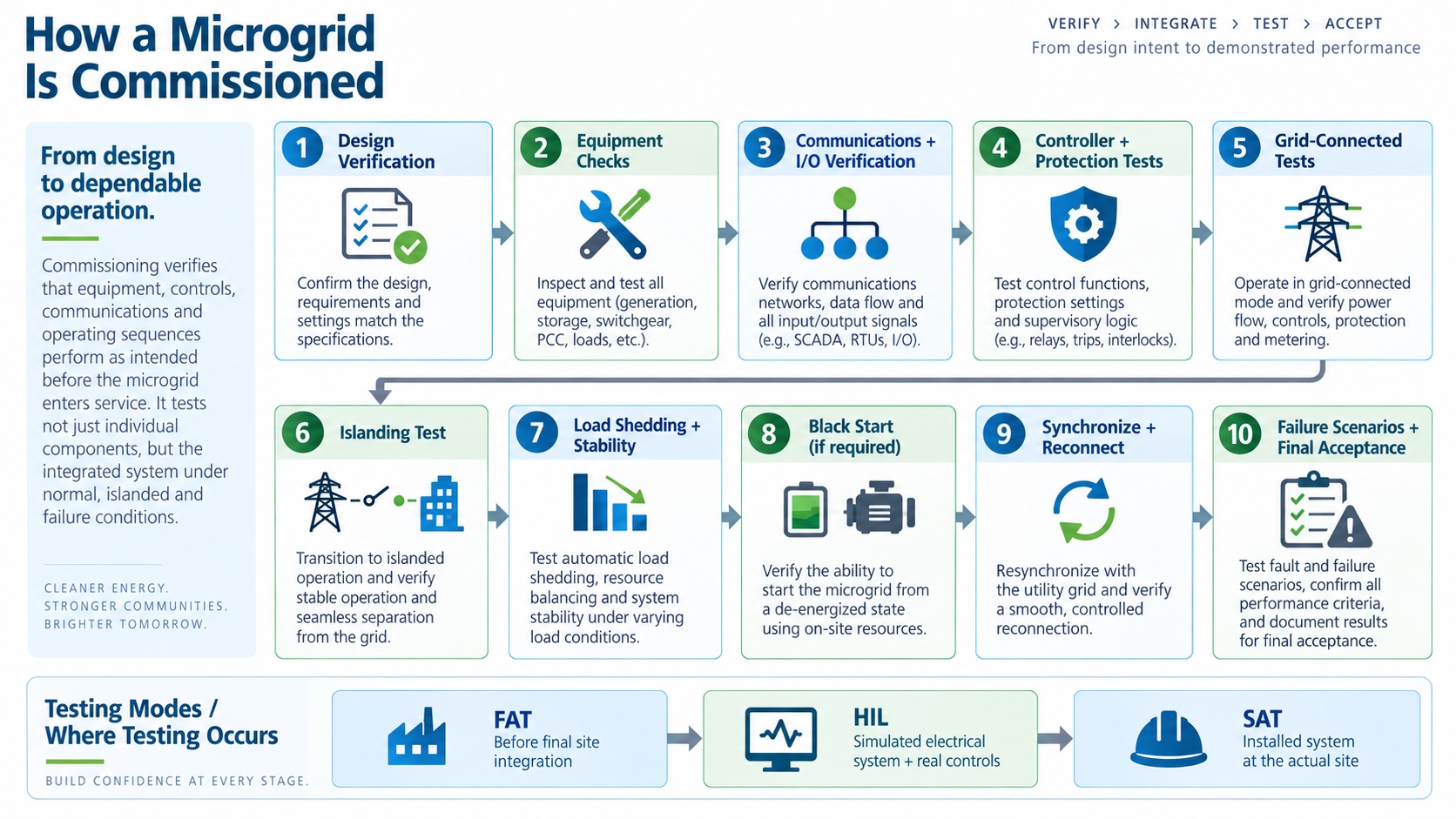
Projects differ, but testing can be understood as several progressively more integrated stages.
1. Documentation and installation verification
Before functional testing, the team verifies that the installed system matches the approved design and equipment documentation.
Checks can include equipment ratings, wiring, breaker configuration, protective-relay settings, meter installation, network connections, labeling and software versions.
Discovering a wiring or configuration error at this stage is considerably safer than discovering it during a live islanding test.
2. Individual equipment testing
Major assets are tested to confirm their basic functionality.
This can include:
- Battery energy storage
- Solar inverters
- Generators
- Transfer equipment
- Switchgear
- Protection relays
- Meters and sensors
- Controller hardware
The objective is to establish confidence in each building block before testing the complete system.
3. Communications and point verification
Modern microgrids depend heavily on digital communications.
Engineers verify that the controller receives the correct measurements and equipment status and that commands reach the intended device.
A seemingly small mapping error can create serious consequences.
If a controller believes a breaker is open when it is actually closed, subsequent control logic can make decisions using an incorrect model of the electrical system.
4. Control-sequence testing
The team then tests operating sequences.
These can include battery dispatch, generator start and stop, load shedding, renewable curtailment, switching and operating-mode changes.
The goal is not merely to verify that commands are issued. Engineers need to confirm that the complete sequence reaches the intended electrical state.
5. Integrated system testing
Once individual functions have been verified, the system is tested as a microgrid.
This is where commissioning becomes particularly valuable.
Multiple devices and control layers are allowed to interact under representative operating scenarios.
Testing grid-connected operation
Many microgrids spend most of their operating life connected to the utility.
Commissioning therefore verifies ordinary operating functions as well as outage response.
Tests can include:
- Battery charging and discharging
- Solar coordination
- Generator dispatch
- Import limits
- Export limits
- Peak-demand management
- Metering
- Alarm handling
These tests establish a baseline before the more consequential islanding scenarios are attempted.
Testing a grid-to-island transition
Islanding is one of the defining capabilities of a grid-connected microgrid.
The test needs to verify the entire transition rather than merely confirming that the point-of-common-coupling breaker can open.
A successful test may require the system to:
- Detect or receive the islanding condition.
- Open the correct utility interconnection device.
- Establish the intended electrical boundary.
- Balance local generation and demand.
- Maintain acceptable voltage and frequency.
- Shed noncritical loads if necessary.
- Keep critical loads supplied.
IEEE’s 2030.8 standard for testing microgrid controllers provides procedures intended to verify and quantify the performance of common controller functions across different microgrid configurations.
Testing unplanned islanding
A planned islanding test allows the controller to prepare for separation.
A real utility outage may provide little warning.
Testing can therefore include unplanned transitions in which the utility source is removed and the microgrid must respond according to its programmed sequence.
This scenario can expose timing problems that remain hidden during a controlled planned transition.
Testing load shedding
An islanded microgrid cannot depend on the utility to supply a power deficit.
If available local generation cannot support every connected load, the system may need to disconnect lower-priority loads.
Commissioning verifies:
- Which loads are classified as critical
- Which loads are shed first
- How quickly shedding occurs
- Whether the remaining system stabilizes
- Whether loads can later be restored safely
This is where good design of critical-load tiers becomes operationally visible.
Testing microgrid protection
Protection also needs to function under different operating modes.
Fault-current characteristics can change when the utility connection opens, particularly in systems dominated by inverter-based resources.
The microgrid’s relays and breakers therefore need settings and coordination appropriate to the expected configurations.
IEEE published IEEE 2030.12-2025 specifically to guide the design of microgrid protection systems across grid-connected and islanded modes.
Microgrid Media’s microgrid protection systems guide explains why changing fault-current behavior makes this more complicated than conventional distribution protection.
Testing black start
A successful islanding test does not prove that a microgrid can restart after becoming completely de-energized.
That requires black-start capability if the project is designed to provide it.
During a black-start test, the utility is unavailable and the microgrid begins from a de-energized state.
An independently startable resource energizes part of the system. Additional generation and loads are then restored according to the designed sequence.
The Marine Corps demonstrated this in 2020 when MCAS Miramar conducted black-start tests during commissioning. Utility power was removed, the microgrid started, feeders were systematically restored and landfill-gas generation was integrated into the operating system. :contentReference[oaicite:9]{index=9}
Black-start testing should only be performed under an approved test plan with appropriate engineering, utility coordination and safety procedures.
Testing voltage, frequency and power quality
A microgrid can remain energized and still fail to provide acceptable electrical conditions.
Commissioning therefore evaluates whether voltage and frequency remain within project requirements as resources and loads change.
Engineers may observe the system during:
- Large load steps
- Generator starts
- Battery dispatch
- Renewable-output changes
- Islanding
- Load restoration
These tests connect directly to microgrid power quality, where voltage, frequency and waveform behavior can become more challenging after the utility’s strong electrical reference disappears.
Testing reconnection to the utility
The end of an outage creates another critical transition.
The microgrid cannot simply close its interconnection breaker whenever utility power returns.
The two electrical systems need to satisfy the project’s synchronization conditions.
Commissioning verifies that the controller identifies an acceptable utility source, coordinates voltage, frequency and phase as required, commands reconnection correctly and transitions resources back toward their normal grid-connected operating states.
What is hardware-in-the-loop testing?
Not every dangerous or unusual condition needs to be created on the live electrical system.
Hardware-in-the-loop, or HIL, testing connects real control hardware to a real-time simulation of the electrical system.
The controller behaves as though it is operating the actual microgrid while the simulator reproduces grid events, resource behavior and faults.
This allows engineers to test many scenarios repeatedly without exposing the completed facility to every simulated disturbance.
The new IEC TS 62898-3-5:2026 explicitly includes HIL testing alongside commissioning and periodic testing for microgrid monitoring, control and energy-management systems.
Factory acceptance testing vs. site acceptance testing
Some testing can occur before equipment reaches the project site.
Factory acceptance testing (FAT) can verify controller logic, interfaces and equipment functions in a controlled environment.
Site acceptance testing (SAT) verifies performance after the equipment has been installed and integrated with the actual site infrastructure.
The two are complementary.
Factory testing can identify software and configuration problems earlier. Site testing proves that the installed system and its real wiring, communications, switchgear, generation and loads work together.
Failure scenarios matter as much as normal operation
A microgrid built for resilience should not be tested only under ideal conditions.
Useful scenarios may include:
- Loss of utility power
- Generator fails to start
- Battery begins at low state of charge
- Solar production suddenly decreases
- Communications to one device are lost
- A noncritical feeder fails
- A major load starts unexpectedly
- A resource becomes unavailable during islanding
The objective is not to prove that nothing can ever fail.
It is to determine whether the system responds predictably when something does.
Why commissioning documentation matters
A good commissioning program creates an operating record.
Documentation can include:
- Test procedures
- Expected results
- Actual results
- Relay settings
- Controller software versions
- Alarm records
- Waveforms
- Deficiencies
- Corrective actions
- Final acceptance criteria
That record becomes valuable later when software is updated, equipment is replaced or operators investigate an abnormal event.
Commissioning does not end the need for testing
Microgrids change over time.
Batteries age. Firmware changes. New loads are connected. Generator maintenance changes equipment availability. Control software can be updated.
A system that passed commissioning five years ago should not automatically be assumed to behave identically after major modifications.
Periodic testing is therefore part of the lifecycle approach reflected in IEC’s 2026 testing specification.
A practical microgrid commissioning checklist
- Verify installed equipment against design documents.
- Confirm meter and sensor accuracy.
- Verify communications and control points.
- Validate relay and breaker configuration.
- Test individual DER operation.
- Test battery charge and discharge commands.
- Test generator sequencing.
- Verify critical and noncritical load groups.
- Test planned islanding.
- Test appropriate unplanned-islanding scenarios.
- Verify voltage and frequency performance.
- Test load shedding and restoration.
- Test black start if required by the design.
- Test synchronization and utility reconnection.
- Test selected failure and degraded-mode scenarios.
- Document deficiencies and retest corrective actions.
The exact checklist must be project-specific. A remote diesel-solar microgrid and a 100 MW data-center microgrid do not have identical acceptance requirements.
Frequently Asked Questions
What is microgrid commissioning?
Microgrid commissioning is the process of verifying that installed generation, storage, switchgear, controls, protection, communications and operating sequences function together according to the project’s requirements.
What is tested during microgrid commissioning?
Testing can include DER operation, communications, protection, controller logic, battery dispatch, generator sequencing, islanding, load shedding, black start, voltage and frequency performance, synchronization and utility reconnection.
What is the difference between FAT and SAT?
Factory acceptance testing evaluates equipment and control functionality before final site integration. Site acceptance testing verifies that the installed equipment works correctly with the actual electrical system and other project components.
Does every microgrid need a black-start test?
No. Black start should be tested when it is an intended project capability. Some microgrids are designed to ride through an outage or island while still energized but are not designed to restart independently after a total shutdown.
Why is hardware-in-the-loop testing useful?
HIL testing allows real control hardware to interact with a real-time simulated electrical system, making it possible to evaluate numerous operating and failure scenarios without creating every disturbance on the live microgrid.
Should a microgrid be retested after commissioning?
Periodic or targeted retesting can be appropriate after major software changes, equipment replacement, configuration changes or other modifications that could affect system behavior.
The bottom line
Microgrid commissioning turns design intent into demonstrated performance.
Individual equipment specifications cannot prove that a complex microgrid will successfully island, protect critical loads, manage a disturbance, black start or reconnect to the utility.
Those capabilities depend on coordinated behavior among equipment, software, communications, protection and operating procedures.
Testing that behavior before the microgrid is needed in an actual emergency is therefore not an administrative final step. It is one of the most important stages in converting a collection of distributed energy resources into a dependable power system.


