
How to Design a Microgrid: From Load Analysis to System Sizing
Designing a microgrid starts with the loads it must serve, not with solar panels or batteries. Learn how engineers define critical loads, analyze outage requirements, select distributed energy resources, size equipment and test a microgrid design.
Published · 11 min read

Learning how to design a microgrid starts with understanding the electricity loads it must serve, not choosing solar panels, batteries or generators.
A microgrid is a system of interconnected loads and distributed energy resources that can operate as a controllable electrical system. Depending on its purpose, it may reduce electricity costs during normal operation, support renewable generation, provide grid services and continue supplying critical loads when the wider utility system is unavailable.
Those objectives determine almost every major design decision.
A hospital microgrid designed to survive a multiday utility outage has different requirements from a commercial microgrid primarily intended to reduce demand charges. A remote community with no utility connection requires a different resource mix again.
That is why professional microgrid design is an iterative engineering process rather than a matter of combining a predetermined amount of solar and battery storage.
Sandia National Laboratories’ Microgrid Design Toolkit, for example, evaluates alternative designs against user-defined objectives including cost, performance and reliability rather than assuming there is one universally optimal configuration.
How to Design a Microgrid: What Goes Into the Process?
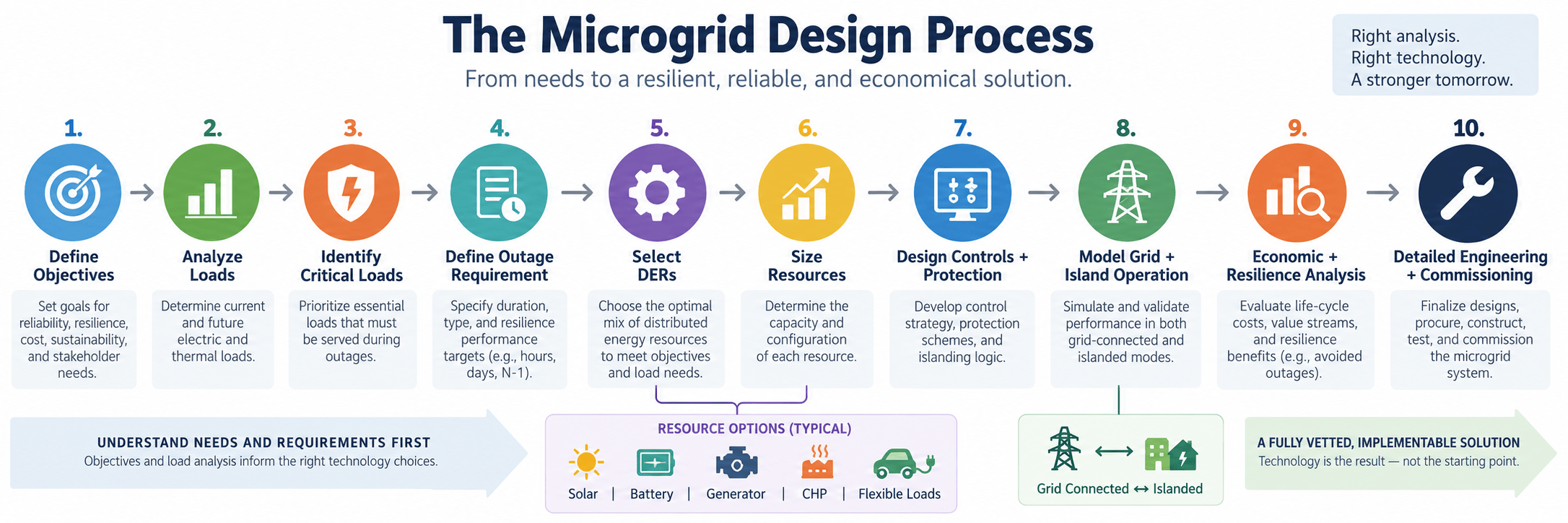
A typical microgrid design needs to answer several interconnected questions:
- Which loads must the microgrid serve?
- How much electricity do those loads consume?
- Which loads are critical during an outage?
- How long must those loads remain powered?
- Which generation and storage resources are available?
- How will the system operate when connected to the utility?
- How will it transition into islanded operation?
- How will voltage and frequency remain stable?
- How will faults be detected and isolated?
- How will the system reconnect to the utility?
- What level of reliability is required?
- What capital and operating cost is acceptable?
Changing one answer can change several others.
Increasing the required outage duration, for example, may require a larger battery, additional fuel storage, more generation or a different strategy for shedding noncritical loads.
Step 1: Define why the microgrid is being built
The first design decision is not technical. It is operational.
What problem is the microgrid expected to solve?
Common objectives include:
- Keeping critical facilities operating during utility outages
- Reducing peak electricity demand
- Increasing use of on-site renewable energy
- Improving electricity reliability
- Reducing exposure to electricity-price volatility
- Serving remote loads without a conventional grid connection
- Supporting large new loads such as data centers
- Providing services to the wider electricity system
The U.S. Department of Energy’s microgrid strategy similarly treats affordability, reliability, resilience, and security as distinct but interconnected microgrid objectives.
A project should therefore establish measurable requirements before equipment is selected.
Step 2: Build the site’s electrical load profile
Microgrid sizing depends heavily on knowing when and how electricity is consumed.
An annual electricity bill provides total consumption, but that alone is not enough.
Engineers generally need interval data showing how load changes throughout the day and across seasons.
The relevant characteristics can include:
- Peak demand in kilowatts or megawatts
- Minimum demand
- Daily energy consumption
- Seasonal demand patterns
- Weekday and weekend differences
- Large motor or equipment startup loads
- Expected future load growth
A site that reaches 5 MW for only a few hours each year presents a different design problem from a facility that continuously consumes close to 5 MW.
Step 3: Separate critical and noncritical loads
A resilience microgrid does not necessarily need to power every electrical load during an outage.
Instead, engineers identify which loads must continue operating.
For a hospital, critical loads may include clinical systems, emergency lighting, communications and selected HVAC equipment.
For a data center, critical loads include computing, networking and the cooling systems required to keep that computing equipment operating.
For a municipal microgrid, police, fire, emergency communications and shelters may receive priority.
This distinction is fundamental to microgrid resilience. Reducing the amount of load that must be supported during an outage can substantially reduce the amount of generation and storage required.
Step 4: Define the outage the microgrid must survive
Once critical loads are known, the next question is duration.
Does the microgrid need to support them for:
- Several seconds?
- Several hours?
- 24 hours?
- Three days?
- A week or longer?
There is no universally correct duration.
The appropriate requirement depends on the site’s risk profile, historical outage experience, criticality and available fuels or renewable resources.
A battery can provide extremely fast power but contains a finite amount of stored energy. A generator can potentially operate much longer if fuel remains available. Solar can replenish energy during daylight but varies with weather.
Combining resources is often more useful than maximizing one technology.
Step 5: Evaluate existing electrical infrastructure
Many microgrids are built around infrastructure that already exists.
A facility may already have:
- Emergency generators
- Solar PV
- Uninterruptible power supplies
- Electrical substations
- Automatic transfer switches
- Building-management systems
- Combined heat and power equipment
Engineers need to determine which assets can become part of the microgrid and which require modification or replacement.
Using existing equipment can reduce project cost, but legacy equipment may not have been designed for bidirectional power flow, islanded operation or automated microgrid control.
Step 6: Select the distributed energy resources
A microgrid can combine several types of distributed energy resources.
Solar PV
Solar provides fuel-free electricity and can reduce daytime grid purchases, but its output depends on available sunlight.
Battery storage
Batteries can respond almost instantly to changing loads, shift solar production across time, reduce peaks and support islanded operation.
Battery design requires both a power rating and an energy rating. A 1 MW battery describes how much instantaneous power it can deliver, while its megawatt-hour rating determines how long it can sustain that output.
Dispatchable generators
Natural-gas, diesel, biogas and other generators can provide sustained dispatchable electricity when fuel is available.
Combined heat and power
Facilities with substantial simultaneous electricity and thermal demand may use cogeneration to produce useful heat alongside electricity.
Flexible loads
Not every balancing resource needs to generate electricity. Some loads can be reduced or shifted when the microgrid is constrained.
Step 7: Size the generation and storage
Microgrid sizing is an optimization problem rather than a simple capacity calculation.
A system could theoretically install enough generation to meet the site’s absolute maximum demand, but that may create unnecessary cost.
Alternatively, engineers can prioritize loads, combine multiple resources and use storage to cover short-duration peaks.
Sandia’s Microgrid Design Toolkit documentation separates economic sizing for grid-connected operation from reliability analysis during islanded operation, illustrating why both conditions need to be considered.
The optimal system may therefore depend on several simultaneous constraints:
- Capital cost
- Fuel cost
- Electricity tariffs
- Renewable-resource availability
- Outage duration
- Required reliability
- Battery degradation
- Generator maintenance
- Emissions requirements
Step 8: Determine how the microgrid will operate
Equipment capacity alone does not determine whether a microgrid works.
The resources need an operating strategy.
The microgrid controller coordinates solar, batteries, generators, loads and the utility connection so the collection of individual devices operates as one electrical system.
During normal grid-connected operation, the controller may minimize electricity cost or maximize renewable consumption.
During an outage, the objective changes.
The controller may:
- Disconnect from the utility
- Shed noncritical loads
- Start generators
- Dispatch batteries
- Limit solar production when necessary
- Maintain battery reserves
- Prepare the system for utility reconnection
Step 9: Design the islanding strategy
A grid-connected resilience microgrid needs a defined electrical boundary.
At the appropriate point of common coupling, switching and protection equipment separate the microgrid from the utility when required.
After separation, local resources must maintain the electrical system without relying on the wider grid.
This changes the engineering problem considerably.
The utility normally provides a strong voltage and frequency reference. Once the microgrid islands, a local resource needs to support those conditions.
Grid-forming inverter technology is increasingly important for microgrids with large amounts of battery storage and inverter-based generation.
Step 10: Design the protection system
Electrical faults still occur inside a microgrid.
Protection becomes more complicated because fault-current behavior can change when the utility connection opens.
A protection scheme therefore needs to account for both grid-connected and islanded operation.
Step 11: Plan for black start
A microgrid may successfully island during many outages but still experience a complete shutdown under severe conditions.
If the utility is unavailable and the local system is already de-energized, a microgrid black-start strategy provides a path for restoring local power.
The process may use a battery, generator or another independently startable resource to establish an energized bus before additional generation and loads are restored progressively.
Not every microgrid requires black-start capability, but critical facilities should decide explicitly whether it is part of the resilience requirement.
Step 12: Evaluate utility interconnection requirements
A grid-connected microgrid cannot be designed independently of the utility system.
Interconnection requirements affect protection, switching, metering and how distributed resources behave during abnormal grid conditions.
Projects should identify utility requirements early because interconnection studies can influence both schedule and equipment selection.
Step 13: Model economics and resilience together
The least expensive microgrid is not necessarily the most resilient, and the most resilient design is not necessarily economically practical.
This tradeoff is one reason optimization tools are useful.
Sandia’s resilient-energy research specifically examines multi-objective microgrid designs that balance cost and resilience.
Economic analysis can include:
- Capital expenditure
- Operations and maintenance
- Fuel
- Utility energy charges
- Demand charges
- Battery replacement
- Financing
- Available incentives
- Potential grid-service revenue
Resilience analysis considers a different question: what happens when the utility is unavailable?
A robust design evaluates both.
Step 14: Test different failure scenarios
A microgrid should not be evaluated only under ideal conditions.
Design models can test scenarios such as:
- Utility outage during peak demand
- Low battery state of charge
- Generator unavailable for maintenance
- Several cloudy days
- Loss of a major inverter
- Unexpected load growth
- Fuel interruption
A design that works only when every resource is available simultaneously may not provide meaningful resilience.
Step 15: Move from conceptual design to detailed engineering
Early-stage modeling identifies promising configurations, but it is not a substitute for detailed engineering.
Sandia’s Microgrid Conceptual Design Guidebook describes conceptual design as roughly 10% to 20% complete and emphasizes evaluating site-specific threats, needs, limitations and investment options before detailed implementation.
Later engineering can include:
- Power-flow studies
- Short-circuit studies
- Protection coordination
- Grounding design
- Equipment specifications
- Communications architecture
- Cybersecurity
- Permitting
- Construction drawings
Step 16: Commission the completed microgrid
Commissioning verifies that the installed system behaves as designed.
Testing may simulate loss of utility power, generator failure, battery dispatch, load shedding, islanded operation, protection events, black start and resynchronization.
This matters because a microgrid is an integrated system. Individual components can function correctly while the overall sequence still fails.
What is a microgrid feasibility study?
A microgrid feasibility study is an early-stage assessment that determines whether a proposed microgrid is technically and economically practical.
It typically combines load analysis, critical-load identification, resource assessment, preliminary equipment sizing, operating scenarios, resilience modeling, interconnection considerations and financial analysis.
The objective is not to produce final construction drawings. It is to determine which concepts deserve more detailed engineering.
What data is needed to design a microgrid?
Useful starting information typically includes:
- 12 months or more of interval electricity data
- Utility tariffs
- Single-line electrical diagrams
- Existing generator specifications
- Existing solar and storage information
- Critical-load requirements
- Outage history
- Available roof or land area
- Fuel availability
- Expected future loads
Better input data generally produces more defensible design decisions.
Frequently Asked Questions
How do you design a microgrid?
Microgrid design begins by defining project objectives and analyzing electrical loads. Engineers then identify critical loads and outage requirements, evaluate available distributed energy resources, size generation and storage, develop controls and protection, analyze grid interconnection and test the proposed system under different operating and failure scenarios.
How do you size a microgrid?
Microgrid sizing uses load profiles, critical-load requirements, outage duration, renewable-resource availability, generator characteristics, battery capacity, reliability targets and economic constraints. There is rarely one correct capacity based only on peak demand.
How much battery storage does a microgrid need?
Battery capacity depends on the power the battery must deliver, how long it must provide that power, available generation, allowable depth of discharge, efficiency, reserve requirements and the battery’s role during normal operation.
Does every microgrid need solar panels?
No. A microgrid is defined by controllable loads and distributed energy resources within an electrical boundary, not by any specific generation technology. Microgrids can use solar, batteries, generators, CHP, fuel cells, wind or other resources in different combinations.
Does every microgrid need battery storage?
No. Batteries provide fast response and operational flexibility, but some microgrids can operate using dispatchable generators or other resources. The appropriate resource mix depends on the site’s objectives and electrical requirements.
What is the most important part of microgrid design?
Defining the loads and operating requirements is foundational. Equipment cannot be sized correctly until engineers know what the microgrid must power, for how long and under which conditions.
The bottom line
Knowing how to design a microgrid means starting with requirements rather than technologies.
Engineers first determine what must remain powered and under which conditions. Only then can they determine the appropriate combination of solar, batteries, generators, controls, switchgear and protection.
The strongest designs evaluate economics and resilience together, model multiple operating conditions and recognize that the microgrid must function as an integrated electrical system rather than a collection of individual energy technologies.


