
Grid-Forming vs. Grid-Following Inverters: Why the Difference Matters for Microgrids
Grid-forming and grid-following inverters can both connect batteries and renewable resources to AC power systems, but they behave very differently. Learn why the distinction matters for microgrid islanding, voltage and frequency control, black start and protection.
Published · 10 min read

A grid-forming inverter can establish and regulate an AC voltage and frequency reference instead of depending entirely on an already energized grid to provide one. That capability is increasingly important in microgrids built around battery storage, solar and other inverter-based resources.
Most conventional renewable-energy inverters have historically been grid-following. They synchronize their output to an existing electrical waveform and inject power into a system whose voltage and frequency are already being established elsewhere.
That works well while a strong utility grid is present.
But a resilience microgrid must also answer a harder question: what establishes the electrical reference after the utility connection opens?
The answer may be a synchronous generator, but increasingly it can be a grid-forming inverter connected to battery storage or another suitable energy resource.
What is a grid-forming inverter?
A grid-forming inverter is a power-electronic inverter controlled so that it can establish or regulate local AC voltage and frequency rather than simply following an external electrical waveform.
The Idaho National Laboratory’s GridTechPedia describes grid-forming inverters as devices that autonomously set and maintain grid frequency and voltage. The technology can support autonomous operation, voltage and frequency regulation, and—when the overall system is appropriately designed—black start and other resilience functions.
See the INL grid-forming inverter overview for the laboratory’s current technology assessment.
This does not mean an inverter contains an unlimited source of electricity. Control capability and energy availability are separate issues.
A battery inverter can form an electrical grid only while the battery and inverter remain within their power, energy, thermal and current limits.
What is a grid-following inverter?
A grid-following inverter operates by synchronizing with an existing voltage and frequency reference.
In simplified terms, the grid tells the inverter what electrical waveform exists, and the inverter controls the current it injects into that waveform.
Grid-following operation has been widely used for solar PV and other inverter-based resources because conventional utility systems already contain strong electrical references established largely by synchronous machines.
The difficulty appears when the reference disappears.
If an island contains only resources that require somebody else to establish voltage and frequency, none of them can independently create the local electrical system they are designed to follow.
Grid-forming vs. grid-following inverters at a glance
| Characteristic | Grid-Forming | Grid-Following |
|---|---|---|
| Basic behavior | Acts broadly like a controlled voltage source | Acts broadly like a controlled current source |
| Needs an existing AC reference | Can operate without relying entirely on one | Normally synchronizes to an existing reference |
| Islanded microgrid role | Can establish or regulate the local electrical reference | Can operate when another suitable resource establishes the reference |
| Voltage and frequency | Can actively establish/regulate them | Normally follows the system voltage and frequency |
| Black-start relevance | Potentially useful when paired with an appropriate energy source and system design | Cannot normally energize a dead AC bus by itself |
| Control complexity | Higher system-integration and validation requirements | Mature and widely deployed |
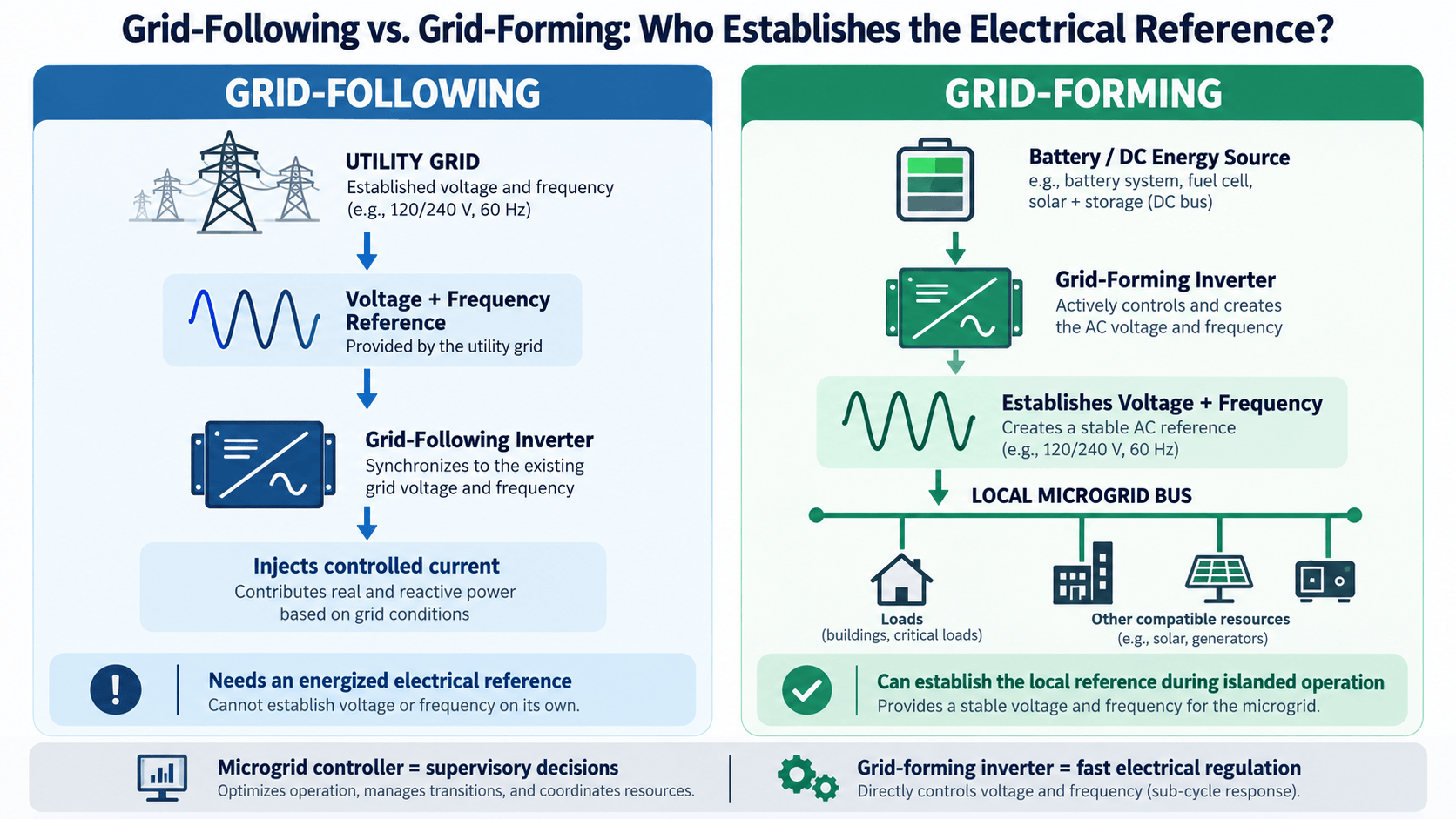
The distinction is about control behavior, not simply whether an inverter is connected to solar or a battery.
Why microgrids need something to form the electrical reference
An AC electrical system requires coordinated voltage, frequency and phase conditions.
While a microgrid is connected to the utility, the larger power system normally provides a strong reference.
The situation changes when the point-of-common-coupling breaker opens.
The local microgrid now needs a resource capable of supporting its own electrical conditions.
Historically, a diesel, natural-gas or other synchronous generator could perform that role. Its rotating machine inherently participates in establishing voltage and frequency.
Microgrids containing large amounts of battery storage and inverter-connected renewable generation can use another architecture: one or more inverter-based resources can operate with grid-forming controls while other resources coordinate around them.
This is why Microgrid Media’s guide to microgrid design treats islanding strategy as a system-level engineering decision rather than simply a switching event.
What happens when a microgrid islands?
Consider a campus connected to the utility while operating solar PV and a battery.
Immediately before an outage, the utility may be supplying part of the campus demand and providing the electrical reference used by the inverter-based resources.
When the utility connection opens, several things must happen in a coordinated sequence.
Local generation must match the load closely enough to prevent unacceptable frequency excursions. Voltage must remain within operating limits. Batteries, generators and controllable loads may need to change output quickly. Noncritical demand may need to be shed.
Most importantly, something inside the island must maintain the AC system.
A grid-forming battery inverter can potentially provide that reference while the microgrid controller coordinates higher-level resource dispatch.
A grid-forming inverter is not the microgrid controller
This distinction is important.
The microgrid controller generally operates at a supervisory level. It may decide when to island, how much battery reserve to maintain, when generators should start, which loads should be shed and how resources should be economically dispatched.
The inverter performs much faster power-electronic control.
It regulates electrical quantities at the device level according to its configured operating mode.
A useful simplification is:
- Microgrid controller: decides what the microgrid should do.
- Grid-forming control: helps establish the electrical conditions that allow the island to operate.
The two systems therefore complement rather than replace each other.
How grid-forming controls support voltage and frequency
Traditional synchronous generators have rotating mass and electromagnetic characteristics that naturally influence grid frequency and voltage.
Power-electronic inverters behave differently because their electrical response is created through controls.
A grid-forming control system can regulate the inverter so it behaves broadly as a controllable voltage source behind an impedance.
Different implementations may use droop control, virtual synchronous machine concepts or other control strategies.
The specific algorithm matters to engineers, but the practical point is simpler: the inverter is not waiting passively for another device to define the waveform.
It actively participates in establishing the local system.
The DOE-supported UNIFI consortium has developed vendor-agnostic specifications for grid-forming inverter-based resources, including both power-system-level and inverter-level functional requirements. The current specification work is available through the DOE OSTI repository.
Grid-forming inverters and battery storage
Battery energy storage is a natural platform for grid-forming functionality because a battery can both absorb and supply electrical energy through a bidirectional inverter.
During an islanding event, a battery may respond rapidly while slower dispatchable generation starts or changes output.
But grid-forming capability does not remove battery limitations.
Engineers still need to consider:
- Battery state of charge
- Inverter power rating
- Available energy capacity
- Short-duration overload capability
- Thermal limits
- Reserve requirements
- Expected outage duration
- Load-step magnitude
A 2 MW inverter cannot indefinitely support a 3 MW load merely because it is grid-forming.
Likewise, a battery may be capable of maintaining a 1 MW island electrically but lack enough stored energy to sustain that island through a multiday outage.
Why grid-forming does not mean unlimited fault current
One of the most important differences between inverter-based resources and synchronous machines appears during electrical faults.
Traditional protection systems often rely heavily on large fault currents to identify abnormal conditions and operate fuses, breakers and overcurrent relays.
Power-electronic inverters have semiconductor current limits and may contribute much less short-circuit current.
Research from Oak Ridge National Laboratory notes that limited fault current in inverter-dominated islanded microgrids can make conventional overcurrent protection difficult. ORNL has investigated both adaptive relaying and inverter designs intended to increase short-duration fault-current contribution.
The laboratory’s grid-forming inverter protection research illustrates why inverter control and microgrid protection cannot be engineered independently.
Can several grid-forming resources operate together?
Potentially, but coordination becomes important.
A microgrid might contain multiple battery inverters, synchronous generators or other voltage-forming resources.
Those devices need to share load without fighting one another over voltage or frequency.
Droop characteristics, communications, inverter limits, generator dynamics and protection settings can all affect the result.
This is one reason grid-forming capability should be treated as a validated system function rather than a checkbox on an equipment specification.
What does grid-forming mean for black start?
Black start is one of the clearest applications.
If the utility is unavailable and the local microgrid is completely de-energized, there is no AC waveform for conventional grid-following equipment to synchronize with.
A suitable grid-forming resource can potentially energize the dead local bus, after which additional generation and loads can be restored in stages.
Microgrid Media’s detailed guide to microgrid black start explains this restoration sequence and why energizing transformers, motors and other equipment introduces additional engineering constraints.
Not every device marketed as grid-forming automatically provides black-start capability. The inverter, energy source, auxiliaries, controls, switchgear and restoration sequence must all support the intended function.
Does every microgrid need a grid-forming inverter?
No.
A microgrid with synchronous generators may already have resources capable of establishing voltage and frequency during islanded operation.
Some microgrids never intentionally island. Others may use a combination of synchronous generation and inverter-based resources.
The correct question is not whether every project should purchase a particular technology.
It is:
What resource establishes and maintains acceptable electrical conditions in every operating mode the microgrid is expected to enter?
For increasingly inverter-dominated systems, the answer is often some form of grid-forming control.
Grid-forming capability is becoming a broader grid issue
The technology is no longer relevant only to small isolated microgrids.
As conventional synchronous generation is displaced by inverter-based solar, wind and battery resources, larger power systems are also examining how grid-forming behavior can support system strength and stability.
INL’s GridTechPedia rated the technology at Technology Readiness Level 8 in its March 2026 assessment, while noting continuing challenges around standards, interoperability, validation and integration experience.
Policy is also beginning to reflect the shift. Microgrid Media recently reported that India’s proposed renewable-energy technical rules would introduce grid-forming requirements for qualifying future renewable and battery projects.
That broader transition makes the underlying distinction increasingly important for engineers, project developers and facility owners.
What should a project team specify?
Simply writing “grid-forming inverter required” is not enough for a complex microgrid.
Project teams should define the operating conditions and performance expected from the system.
Questions can include:
- Must the inverter sustain an island without a synchronous generator?
- Must it transition from grid-connected to islanded operation?
- Is black start required?
- What load steps must it tolerate?
- How will multiple forming resources share power?
- What happens when the inverter reaches its current limit?
- How will protection operate during inverter-dominated islanding?
- How will the system resynchronize with the utility?
- Which tests will demonstrate the required performance?
These questions turn a technology label into an engineering requirement.
Frequently Asked Questions
What does a grid-forming inverter do?
A grid-forming inverter can establish or regulate local AC voltage and frequency rather than depending entirely on an external energized grid reference. That makes the control approach particularly useful in islanded and inverter-dominated microgrids.
What is the difference between grid-forming and grid-following?
Grid-following inverters synchronize to an existing electrical waveform and generally behave like controlled current sources. Grid-forming controls can establish a voltage and frequency reference and broadly behave like controlled voltage sources.
Can a grid-following inverter operate in an island?
It can participate in an island if another suitable resource establishes the electrical reference it follows. A collection of purely grid-following resources generally cannot form an energized island by themselves.
Does grid-forming mean black-start capable?
Not automatically. Grid-forming control is an important enabling capability, but black start also requires an available energy source, auxiliary power, sufficient inverter capability, compatible switchgear, controls and a validated restoration sequence.
Can a battery use grid-forming control?
Yes. Battery energy storage systems are a prominent application because their bidirectional power conversion systems can be controlled to establish voltage and frequency while the battery supplies or absorbs energy.
Is grid-forming the same as a microgrid controller?
No. A microgrid controller coordinates the overall system and makes supervisory operating decisions. Grid-forming control operates at the inverter level to help establish and regulate electrical conditions.
The bottom line
The difference between grid-following and grid-forming control becomes most important when the strong external grid disappears.
A grid-following resource asks, in effect, what electrical waveform it should synchronize with. A grid-forming inverter can help provide that reference.
That capability can support islanded operation, inverter-heavy microgrids and black-start strategies, but it does not eliminate fundamental engineering limits involving energy capacity, current, protection, stability or equipment coordination.
For microgrid projects, the important design question is therefore not simply which inverter technology is newer. It is which resources will establish, support and protect the local electrical system across every operating condition the project is expected to survive.


